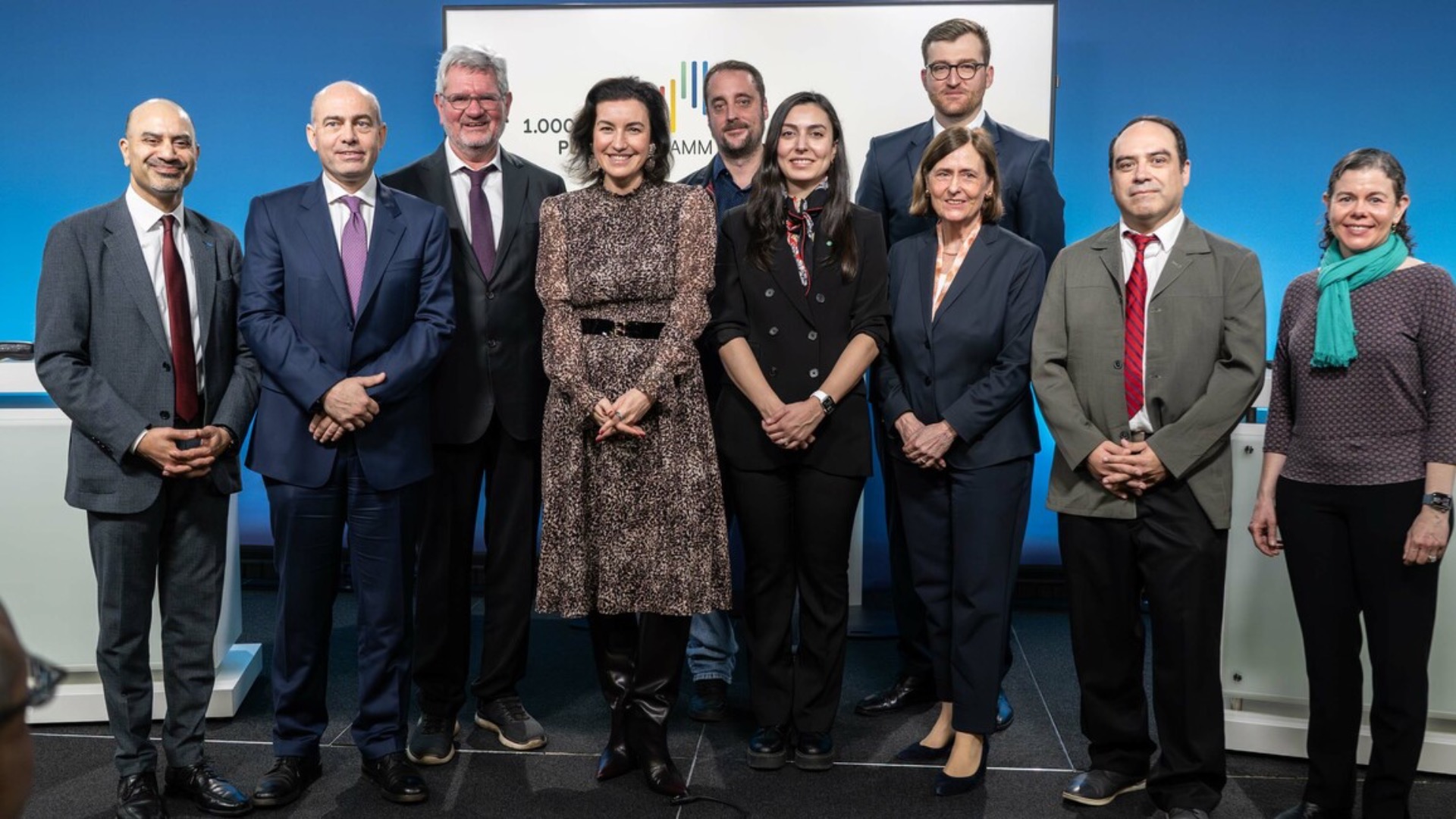
Sigrid: Today we’re joined by Faiza and Mythra. I hope I’m saying your names correctly. This very international radio show keeps us guessing with pronunciations. You’re joining us from High Point in Germany?
Mythra: Yes.
Sigrid: But you’re originally from India. What brought you here?
Mythra: I was working for a German organization in India at an R\&D center, and before COVID, I came to Germany for a six‑month training session. Travel was easy back then, and I fell in love with the amount of research happening here—especially in automobiles, green tech, and similar fields. I decided to quit my job and pursue my master’s at the Karlsruhe Institute of Technology, in southern Germany. If you travel one hour from there, you can reach Switzerland; another hour in a different direction, you could be in Paris.
Sigrid: Exactly like Berlin. Travel one hour away and… you’re still in Brandenburg.
Mythra: (Laughs) That’s how I ended up in Germany.
Faiza: For me, I first visited Europe in 2016—Copenhagen, Denmark—and kept coming back for three years. I loved the people and the work culture. My plan was to move before COVID, but then the pandemic happened. Once it was over, I moved to Europe for work. I’m a software developer.
Sigrid: I’m from Mexico, so I know how wild it is to think, “Yeah, I’m going to move to Germany”—especially given the *amazing* weather here. But we still come. How was it for you to arrive in Germany?
Cultural and Food Shock
Mythra: Honestly, a little shocking—culture, people, food. Indian food is full of spices, and… let’s just say, in Germany, salt is considered a spice. That was an adjustment.
Sigrid: Our producer Marlene just burst out laughing. Marlene, as a German, do you agree that salt is a spice?
Marlene: Most definitely. We have maybe five spices, and salt is one of them.
Sigrid: See? We’re always learning. Now I’ll start seeing salt as a spice. What about chili?
Mythra: It’s usually just red powder—maybe someone got creative. Germans have a low tolerance for heat, but to be fair, food reflects climate and local crops. Still, my biggest surprise was Apfelschorle. I’d never had anything like it. I drank it non-stop for three months before learning you’re supposed to mix it with sparkling water.
Sigrid: I’m still laughing about the “five spices.”
Mythra: I briefly dated a German—it was hard to eat together. She ended up explaining the whole spice situation.
Sigrid: Food reflects geography, yes, but as migrants we also bring our spices, flavors, and colors with us. It adds to Germany’s palette.
Mythra: Exactly—currywurst’s “curry” comes from Indian cooking.
Introducing ZORO Energy
Sigrid: But you’re not only here to talk about food—though we could. Let’s talk about your “baby”: ZORO.
Faiza: ZORO Energy is an AI-powered platform to optimize heating, ventilation, and air conditioning systems—HVAC. Most German buildings didn’t have air conditioning, but with global warming, more are installing these systems. The problem is they’re inefficient and waste a lot of energy.
If your annual energy bill was €10,000, about €3,000 might be pure waste. Prices keep climbing—€0.20 per kWh has become €0.60. And with weather getting more extreme, these systems will become essential. We want them to be efficient so buildings stay comfortable without draining money.
Mythra: We focus on nonresidential buildings—offices, universities—because people spend so much of their lives at work. Comfortable spaces mean happier, more productive people. We also integrate HVAC with battery packs and rooftop solar, so buildings can be autonomous from the grid. That way, even during power outages—like Spain’s massive blackout in 2023—you can keep working in comfort.
Sigrid: In Germany, air conditioning is… a topic. Just yesterday, Pitbull complained on stage in Frankfurt about the heat at his concert. Maybe efficiency will make Germans more open to AC. How do people react when you pitch this idea?
Mythra: Facility managers get it immediately—it’s their job to keep occupants comfortable. In fact, a Dutch company won “Best Startup of the Year” in 2024 doing something similar for homes, but in a very expensive way. We’re focused on nonresidential spaces.
Building a Startup as Migrants
Sigrid: How was it for you, as non-Germans, to go from idea to implementation?
Mythra: Exciting. We’ve wanted to create something of our own for about seven months. We found a great community outside Berlin—Campus Founders—who helped us refine our idea, understand market penetration, and practice pitching.
Faiza: And the Migrant Accelerator helped with the migrant-specific side—visa processing, registering a company, navigating the *Ausländerbehörde*. Sharmila, the coordinator, introduced us to customer segments we hadn’t even considered. We’re now aiming for our first pilot and revenue by year’s end.
Motivation and Misconceptions About Germans
Mythra: Programs like these are amazing because you meet others in the same boat, and it motivates you to keep going.
Sigrid: Thank you—look, even Marlene’s German heart is smiling.
Mythra: People think Germans aren’t warm, but once they get to know you, boundaries disappear. Until then, though—don’t look at me, don’t talk to me!
Sigrid: My first close German friend once showered with the door open while we were on vacation. I wasn’t sure how I felt about that.
Mythra: And the saunas! Very German.
Life in Heilbronn
Sigrid: How is living in Heilbronn? Coming from Mexico City’s 25 million people, Berlin already feels small. Heilbronn has… what, under 200,000?
Mythra: We might be an exception—we prefer fewer people. India has 1.8 billion; it’s a lot.
Sigrid: And now you’re in a city with 132,000.
Mythra: It’s nice.
Faiza: Small and cute—we see the same faces all the time. Feels like our hometown.
What’s Next for ZORO
Sigrid: Before we wrap up—and hopefully talk again in a year—what’s next?
Mythra: Once we install our system, it needs about three weeks to learn the building’s patterns—when energy demand spikes, when it’s low, how many people are around. After that, it will make automatic adjustments and give recommendations. Our AI, “Asura,” will even chat with you—ask how you’re doing, tell you about upcoming weather changes—and keep everything running efficiently.